

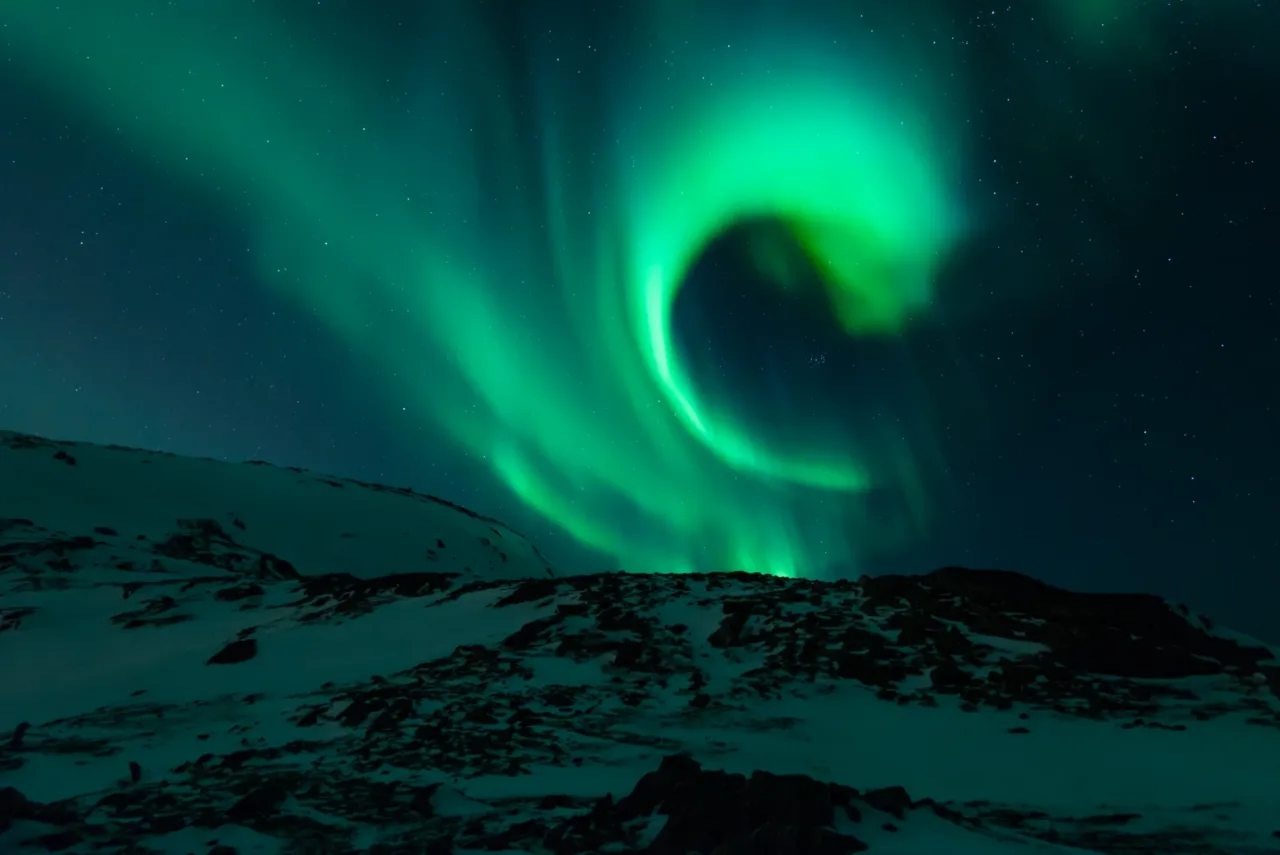
On 14 in October, NASA chose a photograph of Mars and the Beehive Cluster beneath an aurora borealis as its Astronomy Picture of the Day (APOD). Captured near Lansjärv, Sweden, the scene brings together two distinct phenomena: the effects of a solar eruption in Earth’s atmosphere and the planet’s apparent proximity to a group of stars.
The luminous curtain appears above a tree-lined horizon. NASA explains that an eruption from the Sun reached Earth on 10 in October of 2026 and caused strong disturbances in its magnetic field. The energetic particles collided with molecules in the atmosphere and transferred energy to them; as they released it, the molecules produced the colors of the aurora.
The coincidence is in the background of the scene: at the time of the photograph, Mars appeared at its closest position to the center of the Beehive Cluster in the sky. This is a visual proximity. The Beehive Cluster, also known as M44 or Praesepe, is a cluster of young stars.
This star cluster is also valuable for research. Its rotation periods have helped scientists understand how stars spin more slowly over time as they lose mass through their stellar winds. The selected photograph is credited to Petr Horálek, Josef Kujal and Vojan Höfer.