
Europa Clipper is scheduled for a gravity assist with Earth in December 2026. It may seem strange that a spacecraft headed for Jupiter would return near our planet, but that flyby is part of the trajectory designed to provide the energy it needs without carrying the equivalent amount of fuel.
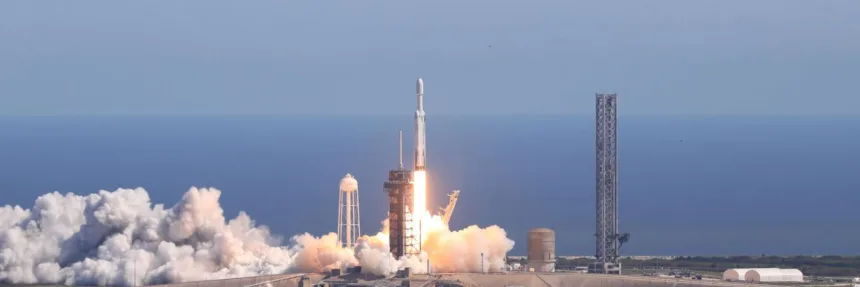
The NASA mission launched on October 14, 2024, and April 2030 remains its scheduled arrival date at Jupiter. Its scientific target is Europa, a moon with an icy crust and evidence of an ocean beneath the surface. This guide explains the next leg of the journey; it does not present a future flyby as if it had already happened.
How a Planet Helps Change Course
A gravity assist takes advantage of a planet’s motion around the Sun. By following a calculated trajectory, the spacecraft exchanges energy and momentum with the planet. Its speed for reaching another world can increase, or its direction can change, without the encounter being a simple engine burn.
It is like choosing a route with connections: the shortest distance on a map is not always one a vehicle can travel with the resources available. In orbital mechanics, the future positions of celestial bodies also matter. The spacecraft must reach the meeting point when the planet is there, too.
What It Will Look for on Europa
NASA describes three main areas of investigation: the structure of the ice and ocean, and the moon’s composition and geology. The goal is to assess whether conditions that could allow life exist. The mission does not promise to find organisms or confirm that Europa is inhabited.
Its suite of instruments includes cameras, spectrometers, radar, and equipment to study fields and particles. Combining observations makes it possible to compare what appears on the surface with signals from the interior and surrounding environment. A mark in the ice, for example, becomes more informative when considered alongside its composition and the structure of the region.
Why It Won’t Orbit the Moon
Europa Clipper will orbit Jupiter and make dozens of flybys of Europa; NASA’s plan describes 49. This architecture makes it possible to observe different areas while limiting prolonged exposure to the intense radiation environment around the moon.
The sequence of observations will be just as important as any single spectacular image. Multiple passes make it possible to build a more complete picture, and measurements need to be cross-checked across instruments. The close approach to Earth is a navigation stage that prepares for this work: the most interesting part of the journey will not be making a loop, but arriving with the trajectory and systems needed to investigate an ocean we cannot see directly.