

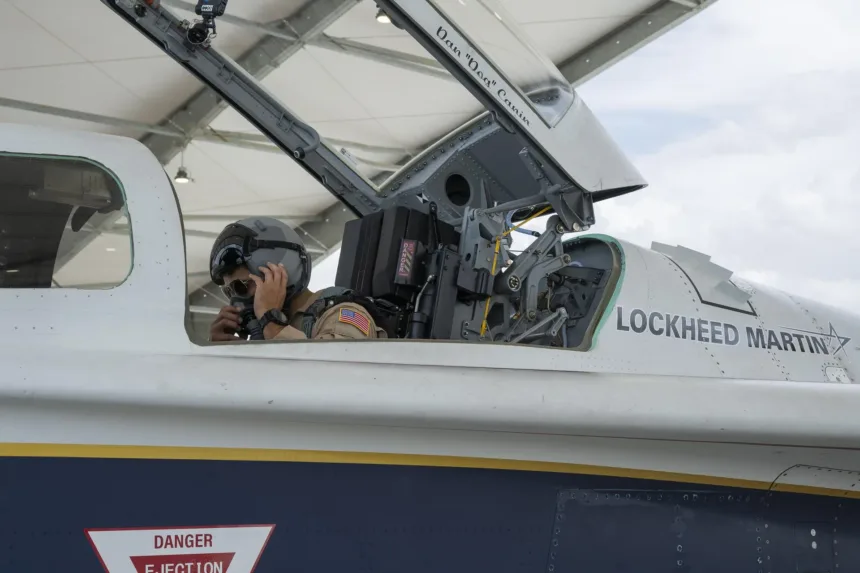
NASA’s X-59 completed six flights during the week of September 21 and reached Mach 1.53, a new top speed for the program. The October 2 report records two flights a day on September 22, 24 and 25, bringing the total to 38. The news shows that the team is expanding the test envelope and increasing its operating pace; speed alone does not resolve the mission’s objective.
Quesst aims to show that it is possible to fly faster than sound while producing a much smaller acoustic disturbance on the ground. The X-59’s reference condition is approximately Mach 1.4 at 55,000 feet, about 16.8 kilometers in altitude. Reaching a higher speed allows researchers to study its behavior, but does not automatically make that flight a validation of the expected noise over a populated area.
Where the sonic boom comes from
An aircraft flying at supersonic speed generates shock waves. When they reach the ground, the rapid pressure changes are perceived as a sonic boom. It is not a noise that occurs only at the instant of “breaking the sound barrier”: the aircraft continues to generate those waves as long as it maintains supersonic flight.
The X-59’s elongated shape is designed to control how those waves form and interact. The aim is to prevent them from combining into a signal as intense as that of a conventional design and to produce a softer thump. The aircraft’s geometry, its trajectory and propagation through the atmosphere are all part of the problem; silencing the engine is not enough.
NASA has set a target of around 75 decibels of perceived loudness for that thump. This is a specific measure of perception, not a figure that should be compared without qualification with any reading from a noise app. Validating the design requires instruments on the ground and data on flight conditions.
What remains after accumulating flights
The program separates aircraft testing, acoustic validation and evaluation of community response. First, it must demonstrate that the aircraft operates as expected and connect what it does in the air with what is measured below. Then, campaigns involving communities will make it possible to gather information about how people perceive those sounds under real-world conditions.
That sequence explains the value of the six flights: more test activity makes it possible to gather data on maneuvers, speeds and altitudes, and to check the aircraft’s consistency. The report also anticipated a maintenance break of about three weeks, a normal part of the test program and not an announcement of commercial service.
The X-59 is a single-seat experimental aircraft. Its contribution will be information for designers and authorities about supersonic noise and public acceptance. The interesting question for future air transportation is not only whether it can go faster, but whether that flight can coexist with people on the ground.