
3I/ATLAS’s passage near the Sun may have stripped away several meters of its surface, making less-altered layers accessible during its interstellar journey. A study estimates erosion equivalent to between 1.7 and 5.2 meters due to gas loss; when dust is included, some scenarios exceed 10 meters. The difference matters for interpreting how much of its chemistry retains signs of another planetary system.
Discovered in July 2025, 3I/ATLAS is the third interstellar object detected. Although it offers an opportunity to study material from beyond the solar system, its surface does not necessarily preserve its original composition intact: energetic particles found in space may have transformed its outer layers.
To estimate how much material solar heating removed, Tessa Frincke and Darryl Seligman, of Michigan State University, analyzed published measurements of gases released before and after the closest approach to the Sun. Their study, accepted by Monthly Notices of the Royal Astronomical Society, estimates a loss of between 18 billion and 58 billion kilograms of gas, mostly water, carbon dioxide and carbon monoxide.
How much the estimate changes when dust is included
Gas was not the only material that may have come off. If the mass of expelled dust equaled that of the gas, the calculated erosion would be 3.4 to 10.5 meters. With a dust mass four times greater, it would rise to between 8.6 and 26.7 meters. These figures describe model possibilities, not depths observed directly.
Converting mass lost into thickness assumes a spherical nucleus with an initial radius of 1.3 kilometers and a density typical of solar system comets. It also distributes erosion equally across the entire surface, so it does not determine how much each region wore away.
Another variable is the duration of activity: the more conservative ranges consider only observed periods; the broader ones extrapolate gas release to intervals without measurements. In addition, the ratio of dust to gas may have varied during the journey.
An earlier model placed the radiation-altered layer at a depth of about 15 to 20 meters. Some scenarios involving dust would reach that level, but they do not prove that intact material was exposed. Chemical changes could also be due to unevenly distributed ices. Comparing the gases released at different stages will help distinguish signs of its origin from the transformations it underwent during its journey.
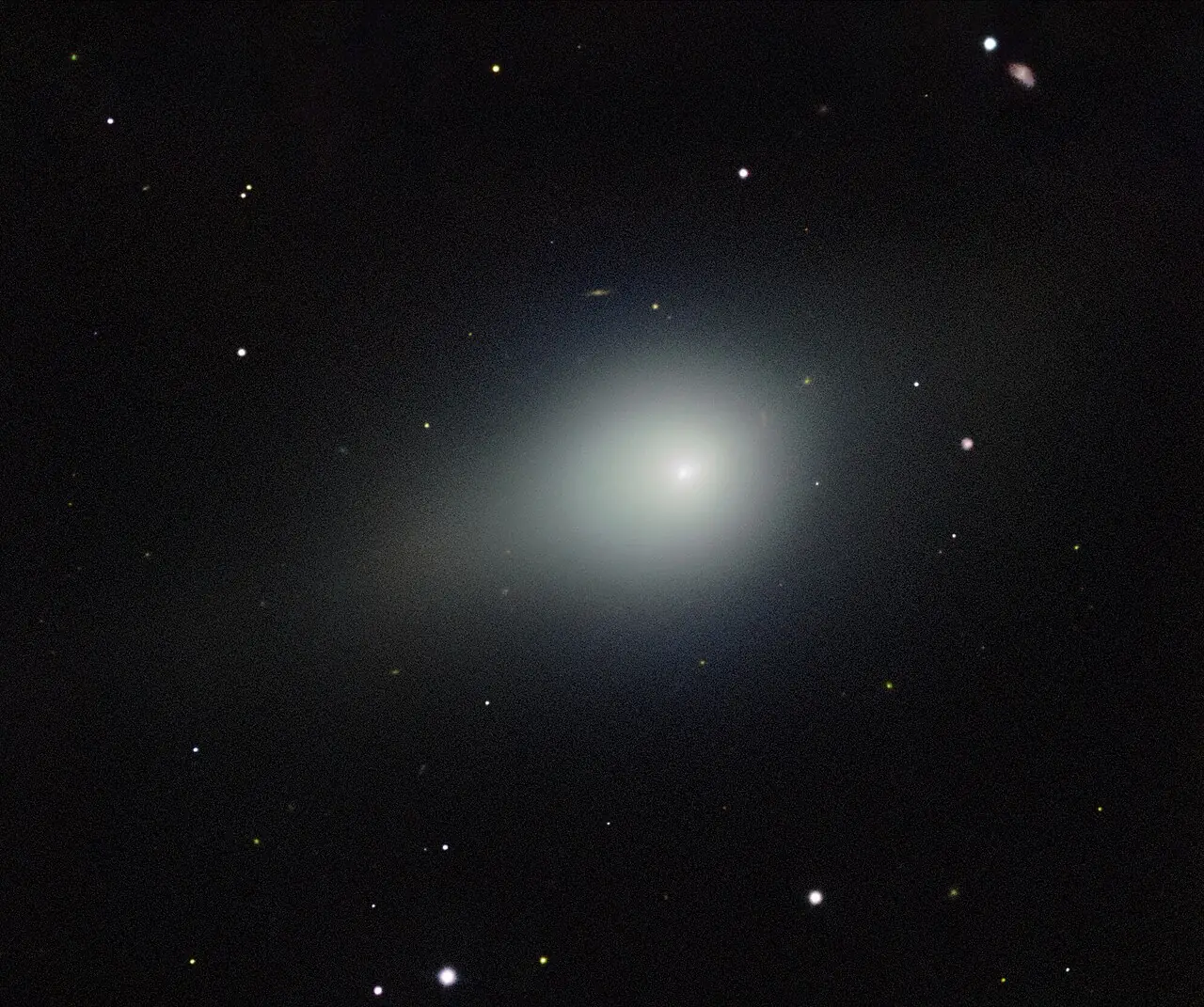
Image: The interstellar comet 3I/ATLAS in a file photo captured on 12 December 2025.