
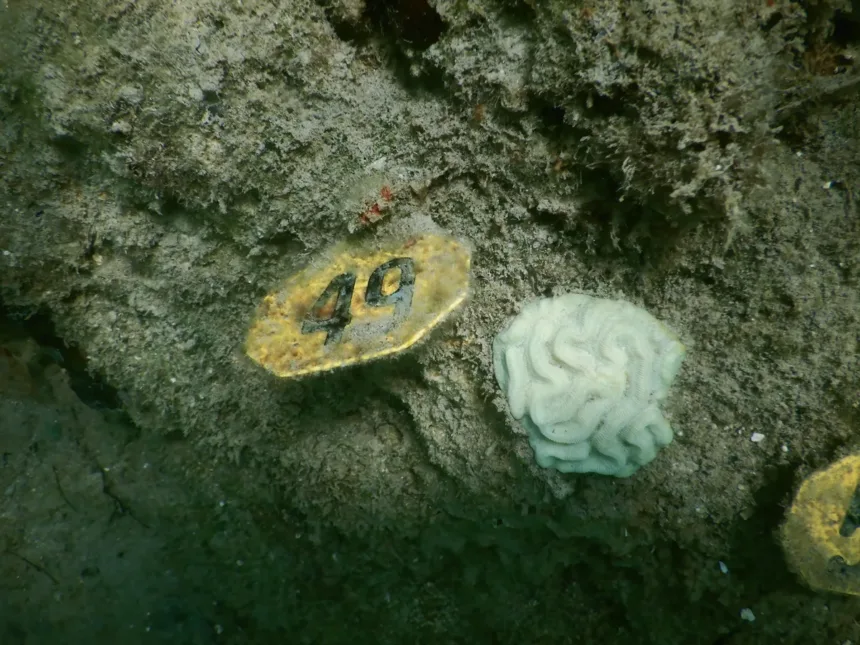
NOAA’s monitoring at Cheeca Rocks, a Florida Keys reef, recorded signs of bleaching starting in early July 2026. Its monitoring page describes the onset of heat stress as earlier than during the 2023 season. The observation matters because of the site’s history and what it makes possible to measure over time.
It does not, by itself, describe the state of all Caribbean reefs. It is a specific monitoring site, with photographs and observations that help compare seasons. Keeping the scale in mind avoids turning a local signal into a worldwide claim without the necessary data.
Where a coral’s color comes from
Many warm-water corals have a relationship with tiny algae that live in their tissues. These photosynthetic organisms contribute to their food supply and color. When stress increases, especially from heat, that relationship can be disrupted, and the coral may lose some of its algae or pigments.
The pale skeleton beneath the tissue then becomes visible. That is bleaching: a sign of stress that can be serious, but does not automatically mean the animal has already died. If conditions improve, some corals can recover; if the problem persists, the loss of energy makes them more vulnerable.
Heat duration changes the risk
A high temperature for a few hours does not necessarily have the same effect as several weeks of exposure. That is why monitoring takes cumulative heat into account and combines it with observations of the reef. Looking at a photograph without a date or thermal context leaves out an important part of the process.
NOAA documents that Cheeca Rocks experienced widespread bleaching in 2023 and mortality among soft corals. Comparing it with 2026 makes it possible to track how a site already exposed to intense events responds. A return of color in an image is not enough to conclude that the entire community has regained its previous structure.
What observing from the water and from space adds
Satellites help identify areas experiencing heat stress across large expanses. Field teams check what is happening to specific organisms and can distinguish species, depth, and tissue condition. The two scales complement each other: a map provides coverage, while an inspection provides detail.
To interpret upcoming updates, it helps to note whether they discuss risk, observed bleaching, mortality, or recovery. These are different states. The 2026 monitoring is valuable because it shows that progression instead of reducing everything to a striking image. The relevant question is how long the stress lasts and how much capacity the reef retains to recover afterward.