
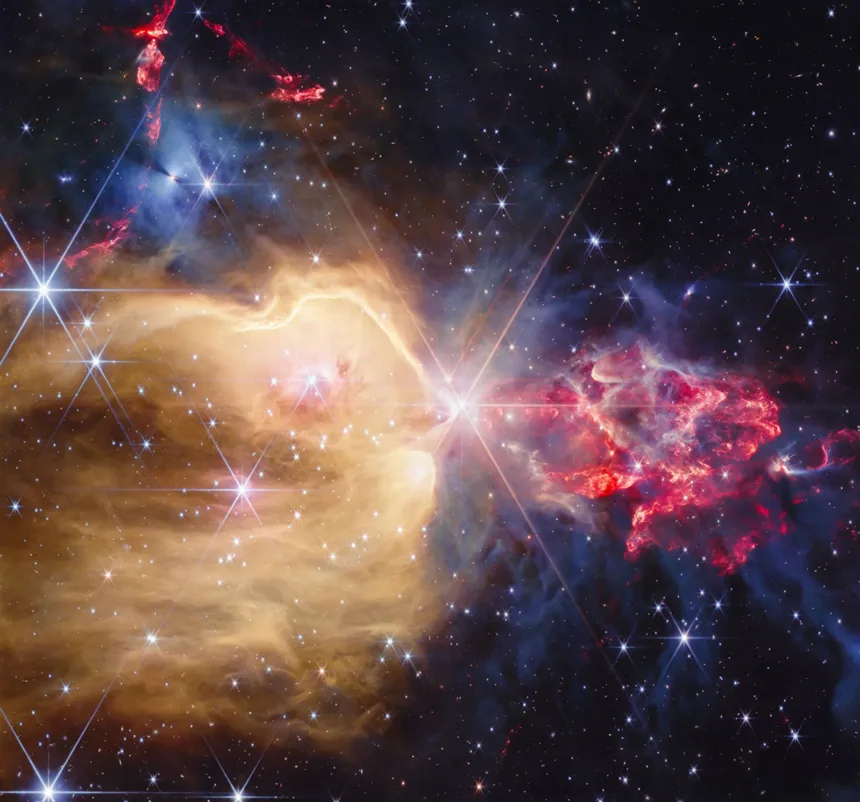
The new image of NGC 7129 taken by the James Webb telescope shows something more interesting than a colorful cloud: stars that are still growing and, as they do, altering the material they were born from. The region is about 3.300 light-years from Earth. NASA published the observation on 6 October, showing a large golden cavity and red structures that make it possible to trace different processes within the same nebula.
The visible star at the center of attention is LkHα 234, a young star with between five and eight solar masses. A cavity approximately 3,5 light-years across stretches to its left: its outflows of material and radiation have altered the surrounding gas. Younger objects, still shrouded in matter, lie to the right. Their coexistence makes the image an opportunity to compare stages of star birth, rather than observe a single isolated object.
What the gold and red mean
According to the explanation from NASA, gold represents hot atomic hydrogen; red represents molecular hydrogen affected by protostellar jets. The colors help distinguish components and processes. They should not be read as a photograph of what an astronaut would see with the naked eye: this is infrared information converted into a visible image.
The jets collide with their surroundings and produce shock fronts. At the same time, the ejected material can clear some areas and compress others. That is the scientific question: how stars transform their birth cloud and change the conditions for new stars to appear. The scene shows this exchange between the objects and their surroundings, not a factory operating uniformly.
Why Webb sees what dust hides
The NIRCam camera works at wavelengths of approximately 0,6 to 5 micrometers. Infrared makes it possible to study some of the light that dust makes difficult to observe in other bands. Its sensitivity and resolution make it possible to distinguish structures that would blend into a single spot in a less detailed observation. To interpret a region like this, it is important both to detect faint light and to distinguish where it comes from.
Star birth begins in dense regions of gas and dust. Gravity concentrates matter; the forming object continues to draw material from its surroundings and may be surrounded by a disk. A protostar and a star that has progressed further toward the main sequence represent different stages of this process. That is why “young star” does not mean that all the bright points in the photo are the same age or behave the same way.
To explore the image, it is worth starting with the large central star, following the edge of the cavity, and then looking for the structures on the red side. This route connects the shapes to their causes: where material has been cleared away, where it remains denser, and where the jets reveal activity. Webb’s contribution is to turn a striking nebula into a map that makes it possible to study these relationships.