
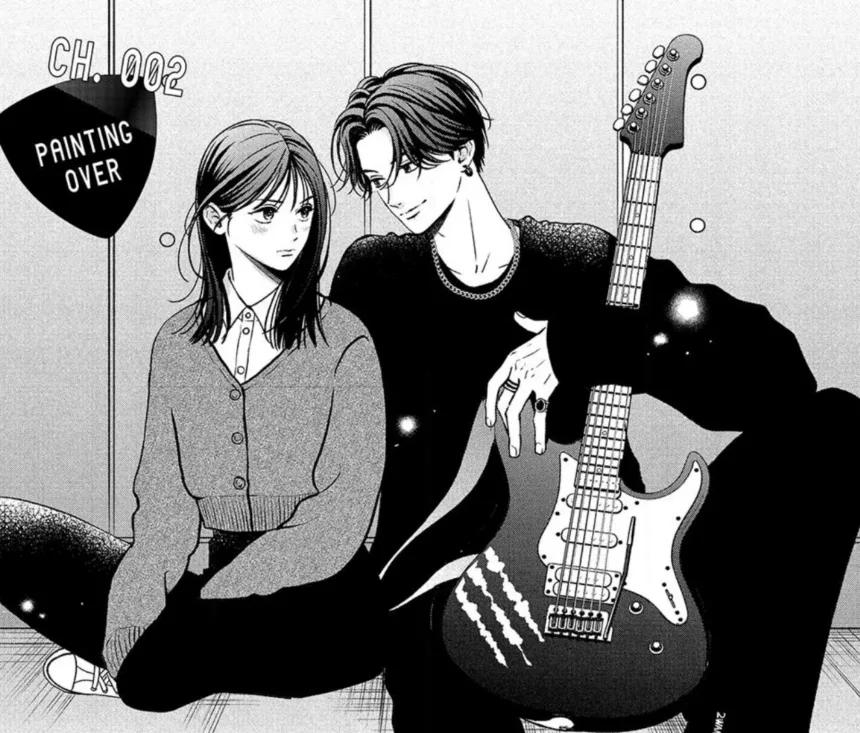
An interview by K MANGA with Keiko Iwashita, published in two parts between September 28 and October 4, offers a look at Choking on Love through its creative process. The romance between Hibari and Gaku is built on a familiar tension: wanting to find your own voice when the person you admire seems to know exactly who they are.
Iwashita says she drew on some of her own experience as an art student to create Hibari. The protagonist studies graphic design, while Gaku specializes in oil painting. The university is more than a decorative backdrop: it lets the story bring together career aspirations, doubts, and relationships beyond the rules of a high school romance.
Someone Else’s Talent as an Uncomfortable Mirror
The author connects Hibari to the feeling of being an ordinary person surrounded by extraordinary creators. For Gaku, she combined traits of people who are intensely devoted to their work. Their differences create attraction, but also admiration and creative jealousy: being close to someone talented doesn’t make it any easier to value your own work.
Another detail from the interview helps explain the story’s structure. Iwashita wanted to explore what happens after a couple gets together, rather than making the entire story a wait for a confession. The relationship opens up new challenges: supporting another person while continuing to build an identity of your own.
How to Draw Music on a Silent Page
In the second part, Iwashita explains that she visited venues such as CLUB QUATTRO, SHELTER, and Zepp to gather references. She also studied videos and photographs of performances. To imagine the performances of the fictional band PANTERA NEGRA, she drew on a range of musicians and Perfume’s stage production.
Observation matters because drawing a recognizable instrument is not the same as conveying a concert. The framing, the musician’s posture, and the audience’s reaction can suggest energy even though the page makes no sound. This is our interpretation of her method: visual research helps readers fill in an experience the medium cannot literally reproduce.
A Relationship That Doesn’t Magically Solve Everything
The author highlights mutual trust and treating each other as equals as cornerstones of the couple’s relationship. This makes it possible to read the romance alongside the process of growth: support can motivate a character, but it can’t make their decisions for them. The interview also leaves room for the challenges of creative work, without presenting inspiration as an inexhaustible resource.
For anyone who draws, composes, or is just starting a project, that is the most interesting angle of the conversation. Insecurity appears not only as a romantic obstacle, but as part of the learning process. This article summarizes Iwashita’s explanations; the interview was conducted by K MANGA and can be read in full in the sources.