

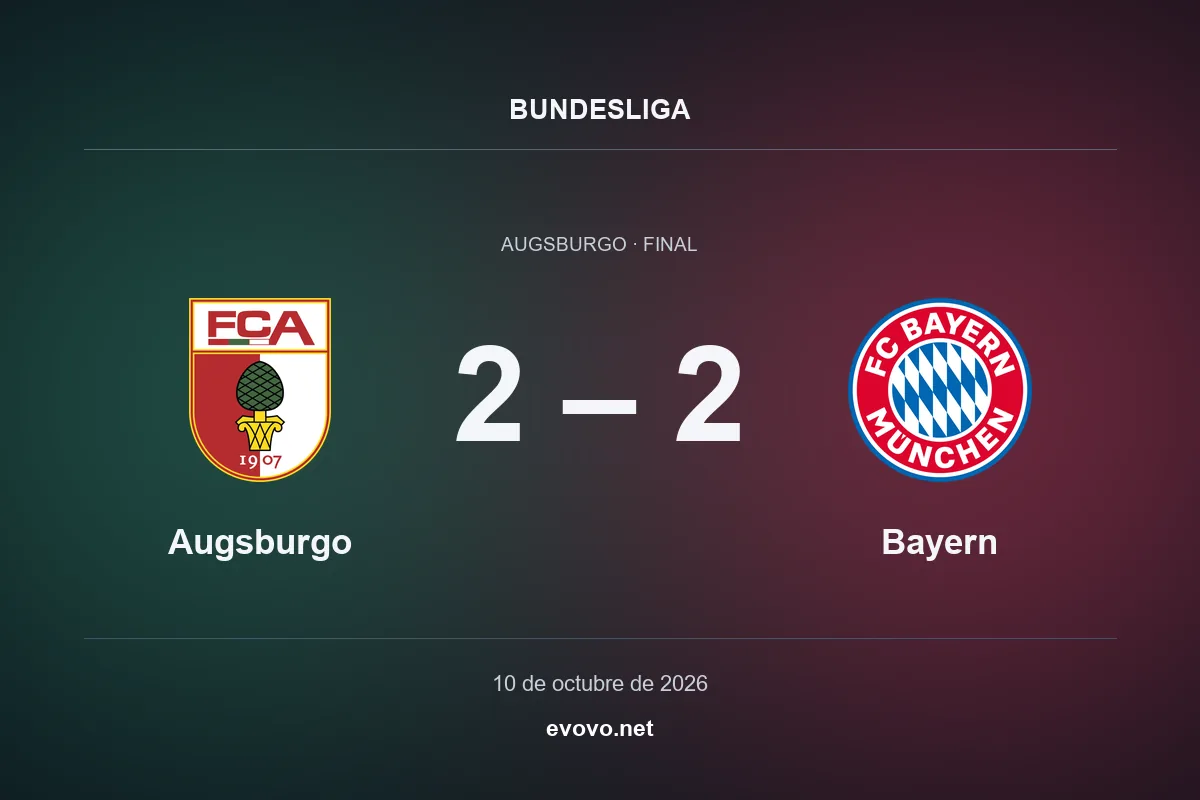
Bayern Munich drew 2–2 with Augsburg in a match that began with a record: Robin Fellhauer scored before nine seconds had elapsed, the fastest goal in Bundesliga history, according to the German league. The Munich side had to come from behind twice to salvage a point.
Ismael Saibari and Nathaniel Brown scored for Bayern; Fellhauer and Rodrigo Ribeiro did so for the home side. Harry Kane assisted both of the visitors’ goals.
A record set by the opening pressure
Augsburg immediately went for the opposing goal. Fellhauer took advantage of a poor touch by Manuel Neuer and made it 1–0 with the match barely underway. The Bundesliga’s official record notes that the goal came in less than nine seconds.
The play left Bayern having to chase the result from the very first attack. The mistake playing out from the back thus had two consequences: it gave the home side the lead and set a historic speed record in the competition.
That start did not mean the match was decided. Augsburg held the lead until halftime, and Bayern found its first response in the second half, in a game in which it had to react more than once.
Two comebacks and two assists from Kane
Saibari made it 1–1 in the 55th minute, after a pass from Kane. Augsburg went back in front in the 64th minute through Ribeiro, who capitalized on a rebound and forced the visitors to begin another search for an equalizer.
Brown made it 2–2 in the 80th minute, with Kane again providing the assist. The English striker did not need to score to play a direct part in both of his team’s goals. The list of scorers and assists makes it possible to distinguish his contribution from that of the two teammates who finished the moves.
Bayern still came close to changing the result: Serge Gnabry hit the post with a shot late in the match. There were also goals ruled out for offside, including a move involving Luis Díaz. Those plays explain some of the tension in the match, but they do not count toward the official score.
A return to league action with points dropped
The match was part of the fifth round and was played after the international break. Bayern came away with a draw from an away game in which it had fallen behind twice. Augsburg, for its part, turned an exceptional start into a match that remained open until the end.
Fellhauer’s record stands on its own, regardless of the draw: the record does not disappear because his team did not win. For Bayern, avoiding defeat does not erase the problems that put it behind from the start.
The result combines both stories: a historic goal in the opening seconds and an opponent that managed to respond but could not complete the comeback. The four valid goals and the final 2–2 are the reference point for the matchday, beyond the chances that did not make it onto the scoreboard.