
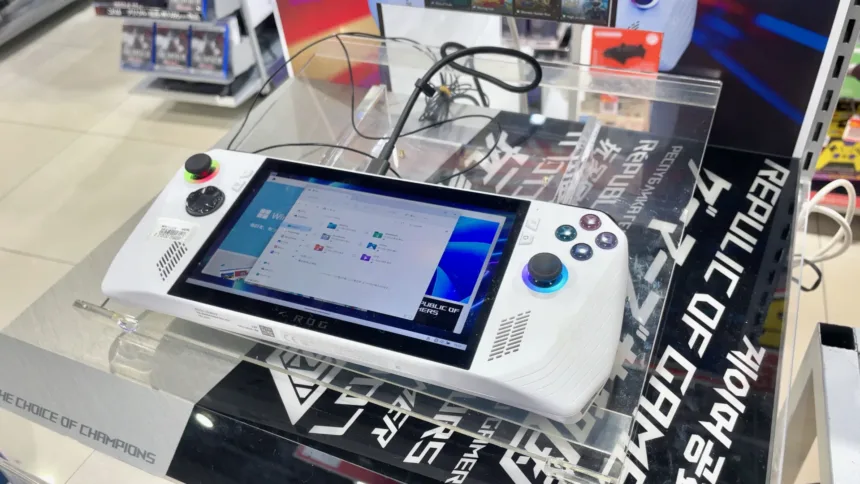
AMD wants to bring FSR 4 to APUs, gaming laptops, and handheld consoles before the end of 2026. Jack Huynh, head of computing and graphics, told Korean media on October 7 that they are working on a lighter model for that environment, with support for existing and new products. The information comes from an interview published by The Elec and also reported by VideoCardz.
The change is especially relevant for integrated graphics. In an APU, the CPU and GPU share system resources and a limited power budget. Reducing the work needed to produce an image can help, but the reconstruction algorithm also has a cost. The useful improvement depends on the balance between the two.
What temporal upscaling does
AMD GPUOpen documentation describes inputs such as the rendered image, depth, and motion vectors. The latter help track the position of elements from one frame to the next. Reconstruction uses this information to produce an output image with more detail than the internal resolution rendered by the game.
For example, 1,280 × 720 contains 921,600 pixels, while 1,920 × 1,080 contains 2,073,600. Rendering at the first resolution means initially working with approximately 44% of the pixels in the second. This is a geometric calculation, not a promise to double FPS: the game still has CPU, geometry, and other effects work that does not disappear when resolution is lowered, and reconstruction takes time of its own.
That is where the appeal of a lighter model comes in. If reconstructing the image consumes too much on a limited chip, it can absorb a significant portion of the savings from rendering fewer pixels. AMD says this adaptation is aimed at quality and low latency; comparable results by APU, game, and mode are still needed before the benefit can be quantified.
FSR is not a single feature
Upscaling and frame generation solve different tasks. The former produces a higher-resolution image from rendering data; the latter creates intermediate frames. GPUOpen documentation presents them as distinct components, with integration and hardware requirements that should be checked separately.
That is why “it will have FSR 4” does not automatically confirm that all features will be available on every desktop graphics card. Nor does the announcement alone identify the architecture of a new APU. The Elec interprets some of the statements as a hint about future hardware, but that reading is no substitute for an AMD product specification.
What to look for when it comes to laptops
The important comparison should use the same game, output resolution, and power limit. In addition to FPS, it is worth checking details in motion: vegetation, cables, particles, edges, and HUD text. A still image can hide trails or instability that appear when the camera moves.
It is also worth measuring what happens to battery life and temperature if the goal is a handheld console. The same savings can be used to increase frame rates, improve quality, or reduce power consumption; you do not necessarily get all of these at once. The final list of supported APUs and compatible games will determine how the announcement translates into a concrete improvement for each system.