
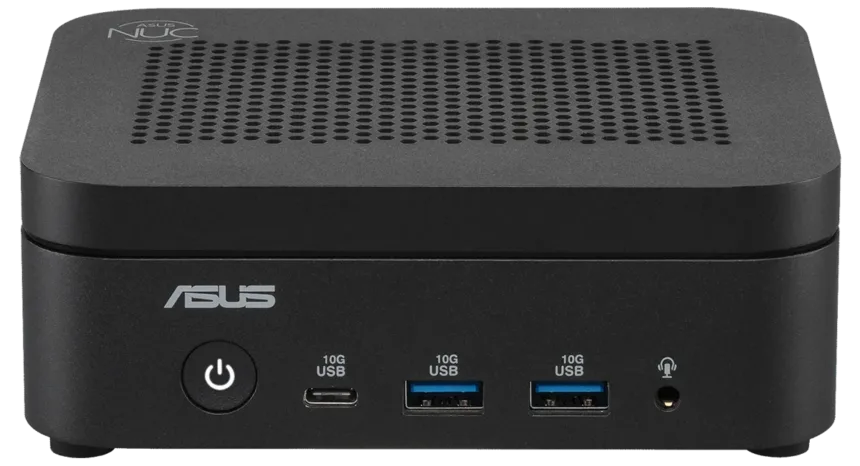
ASUS added a fanless version to its NUC 14 Essential lineup. The official specifications describe a 0.74-liter system weighing approximately 650 grams, with Intel N-series processors, DDR5 memory, and SSD storage. The cooling change is aimed at desktops, digital signage, and workstations where fan noise or maintenance matters more than getting the most power from a small chassis.
The manufacturer’s page lists N100, N150, and N250 configurations. Check the specific processor in the system being offered: sharing the NUC 14 Essential Fanless name does not mean every unit has the same chip, memory, SSD, or installed operating system. ASUS shows access to a DDR5 SO-DIMM module and M.2 storage, two useful details for planning maintenance and upgrades.
Fanless still means heat
Passive cooling transfers heat to a heatsink, which releases it into the air without a fan forcing air to move. It eliminates the noise from that component and one moving part, but it does not eliminate the processor’s thermal energy. Ambient temperature and the space around the system still affect its ability to sustain a workload.
That matters when installing it behind a display or inside a cabinet. A VESA mount can clear the desk, but it does not make every enclosed space suitable. The installation must follow the manual and allow heat to dissipate. “Fanless” describes the cooling method, not a guarantee of identical performance in every environment.
The workload also changes the result. Displaying an information page, using office software, and processing video continuously require different resources. To assess a system like this, it’s useful to run a test long enough for it to reach its operating temperature, in addition to measuring how quickly it opens an application the first time.
Three displays don’t mean gaming in 4K
ASUS advertises support for up to three 4K displays through its HDMI, DisplayPort, and video-capable USB-C outputs. This allows users to spread out windows, control panels, or digital signage content. The ability to send a signal at that resolution is not the same as rendering demanding games across three displays at a high frame rate.
The specifications also include 2.5 GbE networking, Wi-Fi 6E, and Bluetooth 5.3. In a fixed installation, a wired network can be part of a consistent work environment; its effective speed will still be limited by the rest of the network and the data source. The fast port does not, on its own, speed up a slower Internet connection.
For a study or light-work setup, the key questions are specific: how many applications are used at once, how much RAM is included, where the system will be mounted, and what noise you want to avoid. For digital signage, also consider recovery after a power outage and remote management. The fanless NUC makes sense when its design fits those needs, not simply because it is small and has no fan.