
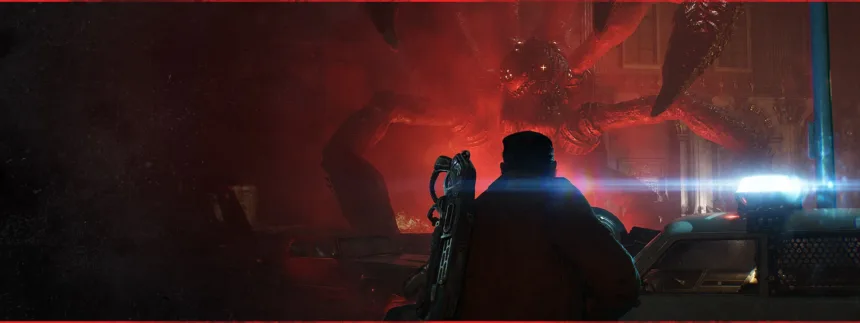
Gears of War: E-Day launched on October 6 for Xbox Series X|S and PC. The campaign returns to the beginning of the Locust invasion, fourteen years before the first Gears of War, with Marcus Fenix and Dominic Santiago. That time gap changes the point of view: the protagonists face the arrival of a threat they do not yet know as they do in later installments.
Xbox places the story in Kalona and describes a mainly linear campaign, with large areas that offer routes and side paths. Linear means there is guided narrative progression; it does not mean every setting is a corridor. The combination may allow players to explore an area or tackle an additional objective without turning the campaign into an open world.
Three different reasons to jump in
The campaign tells of the disaster through the relationship between Marcus and Dom. Horde Siege brings back the co-op mode against enemies controlled by the game, while Versus is for matches between players. They are different experiences within the same release: advancing the story, coordinating a team against threats, and competing against other people call for different expectations.
For someone jumping in for the first time, the prequel framework offers a chronological starting point for the crisis, although longtime fans will recognize characters and references. For returning players, the appeal is seeing them before the events they already know. That context explains the protagonists’ return without revealing the campaign’s ending.
Xbox’s launch guide also notes that the game is available on Steam and Game Pass. For a subscription, your plan and platform listing is the reference for specific access; “it’s on Game Pass” does not describe every subscription option in the same way.
What DLSS, ray tracing, and Mega Geometry mean
NVIDIA announces DLSS 4.5, ray tracing, and RTX Mega Geometry in the PC version. It is worth distinguishing their functions. Image reconstruction starts from an internal resolution and aims to produce a higher-resolution output; frame generation adds frames between rendered ones. Increasing the number of frames shown by a counter does not mean the game calculates new player inputs at the same rate.
Ray tracing addresses how the path of light is simulated for certain effects. Mega Geometry focuses on handling detailed geometry within ray-tracing workloads. The technical idea differs from a simple texture setting: the cost may depend both on scene detail and on the effects selected.
When configuring the game, it is best to start with an output resolution, a smoothness target, and a base quality setting that remain stable. Then you can check the effect of reconstruction and each lighting option separately. Changing everything at once makes it difficult to identify what improves the image and what introduces stuttering or latency.
This is a launch guide and background, not a review of a play session conducted by evovo. The specific takeaway from the launch is that players can now assess the complete offering: how the campaign works in Kalona, what each mode offers, and which settings deliver a consistent experience on each system.