
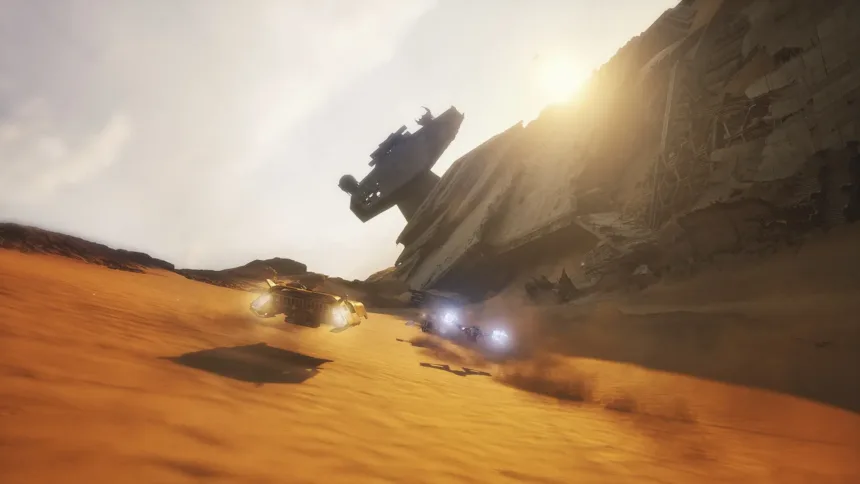
Star Wars: Galactic Racer has been available since October 6 on PS5, Xbox Series X|S, and PC. Developed by Fuse Games, it puts the speed and rivalries of an underground circuit at the center of a racing adventure. The campaign’s protagonist is Shade, a pilot whose pursuit of glory and revenge leads him to the Galactic League.
The setting is a galaxy after the fall of the Empire, where reconstruction exists alongside outlaw businesses and competitions. This approach lets players visit familiar places through a different kind of activity: Jakku serves as a track amid the remnants of war, while Ando Prime offers a different kind of landscape and surface. The setting affects how you approach the race, while also providing references for Star Wars fans.
Choosing a vehicle changes how you take a turn
Fuse and Lucasfilm’s presentation distinguishes between landspeeders, speeder bikes, and skim speeders, among other classes. Matt Webster describes the bikes as having strong braking and acceleration on corner exits; skim speeders favor smooth lines and maintaining momentum. It’s not simply a matter of choosing a different-looking body.
That difference has a tactical consequence: two vehicles can approach the same turn while aiming for different positions. One needs to brake and accelerate hard out of the turn; another loses some of its advantage if it breaks its momentum. When they share the track, their paths cross and contact becomes part of the fight for space.
The launch announcement also features shoves and takedowns during races. The game is about competing for the racing line and managing rivals, as well as memorizing the circuit. To decide whether it’s a fit for you, it’s more useful to think about that interaction than to expect a conventional racing simulation just because it has races and vehicle upgrades.
The campaign asks you to make choices between events
Webster explains that the structure takes inspiration from games organized around routes or attempts: choosing a vehicle, upgrades, and events changes the path to the championship. The choices don’t end when the race begins. Putting together a coherent setup can be just as important as taking a turn well.
The October 6 announcement lays out an important rule: too many crashes end a run and force you to regroup for another attempt. Some perks and unlocks carry over. So the tension isn’t just about winning an event, but deciding how much risk to take to keep a longer run alive.
The Hibi mechanic lets you install parts earned during attempts or bought at its workshop. It connects your results on the track with your preparations for the next race. A useful upgrade should fit your vehicle and chosen style; chasing a single maximum stat may leave unresolved the weakness that’s causing your crashes.
Podracers offer another way to manage speed
The official vehicle guide explains that podracers use ramjets to reach higher speeds and an aerodynamic brake to handle tight turns, with a sharp loss of speed when it’s engaged. That combination creates a familiar trade-off: pushing the boost helps on a straight, but approaching a turn out of position can wipe out the advantage.
The launch trailer also adds Crait to the announced planets, alongside Jakku, Sentinel I, Lantaana, Derven Acos, Ando Prime, and Tatooine. With its settings, vehicles, and persistent choices, the game aims to make learning a track just one part of progression: you also have to learn when to preserve an attempt and when to risk it.