
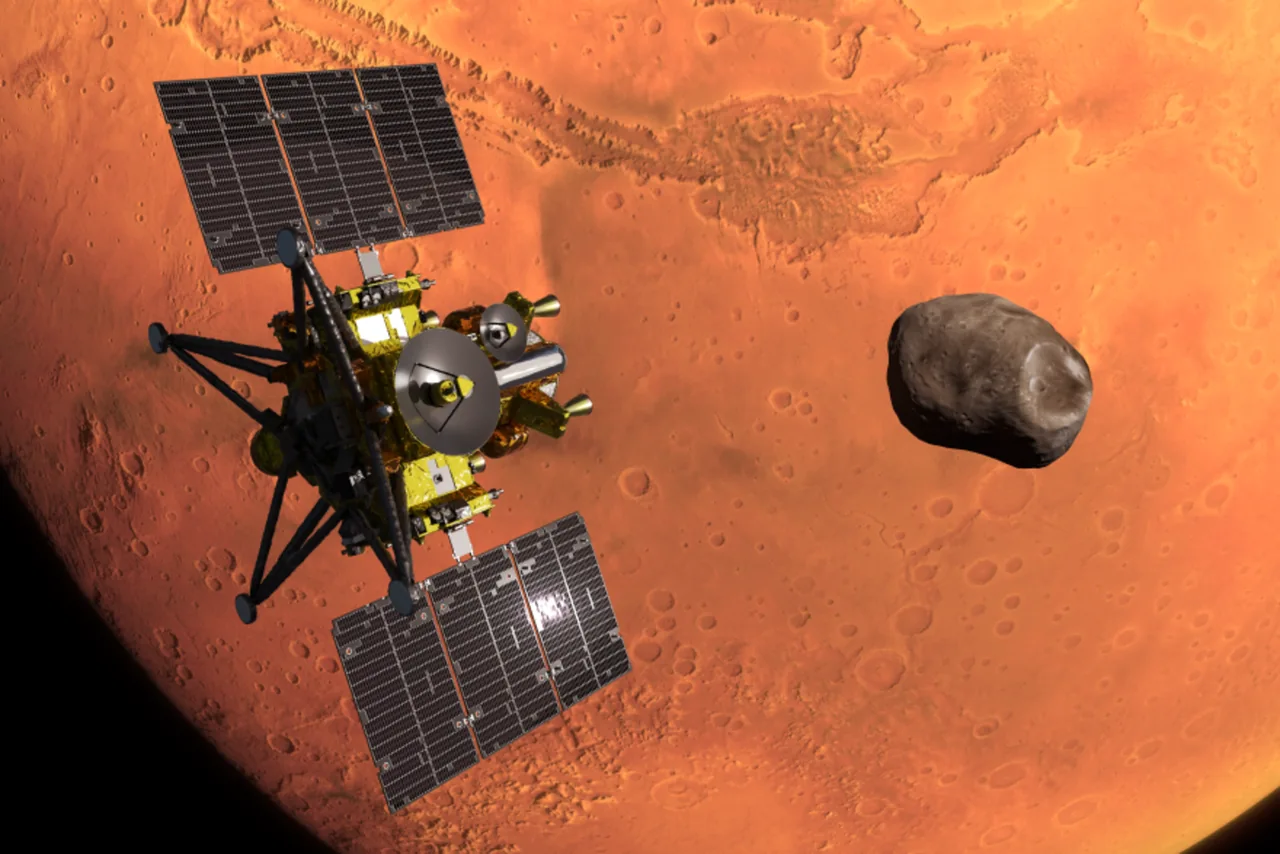
Japan has launched MMX, the mission aiming to return samples from the Martian moon Phobos. JAXA confirmed that the H3 rocket lifted off from Tanegashima at 4:41:03 a.m. on October 20 in Japan. In Mexico City, that was 1:41:03 p.m. on Monday, October 19. Spacecraft separation was confirmed approximately 71 minutes and 13 seconds after liftoff, on the planned trajectory.
This establishes a successful start to the journey, not a successful sample return. Interplanetary travel, close observations, landing and the return flight still lie ahead. Completing those steps would give laboratories on Earth material collected directly from the Martian system.
The mystery behind Mars’s moons
The origins of Phobos and Deimos remain unresolved. One explanation describes them as captured asteroids; another proposes that they formed from debris released by a major impact. Images and orbital measurements offer clues, but cannot settle every question about their composition or formation.
There is an important difference between observing a surface and examining a physical sample. Laboratories on Earth can compare minerals and composition using instruments that would be difficult to carry aboard a spacecraft. The results could help distinguish competing formation scenarios instead of relying mainly on how the moons look.
What MMX will do
The mission will study both moons and aims to collect at least 10 grams of material from Phobos. Sample return is planned for 2031, within a mission lasting roughly five years. Deimos will be observed remotely rather than sampled.
MMX also carries Idefix, the small rover developed by France and Germany to investigate Phobos’s surface. Its weak gravity makes seemingly straightforward operations, such as moving while maintaining contact with the ground, different from driving a rover on Mars.
How the international instruments fit together
JAXA leads the mission with NASA, CNES, DLR and ESA participating. NASA’s contributions include MEGANE, a gamma-ray and neutron instrument designed to investigate Phobos’s composition. Remote sensing, surface exploration and later laboratory analysis will therefore address different parts of the same scientific problem.
A returned sample would also let researchers revisit their conclusions as laboratory methods improve. That is a different scientific resource from a photograph or a single measurement transmitted during a flyby: physical material can support several investigations over time.
This is neither a crewed Mars flight nor an announcement of extraterrestrial life. Its importance lies in a specific question: how these moons formed and what they preserve of Mars’s evolution. Launch begins that investigation; the eventual answers depend on the observations and samples the mission can deliver.