
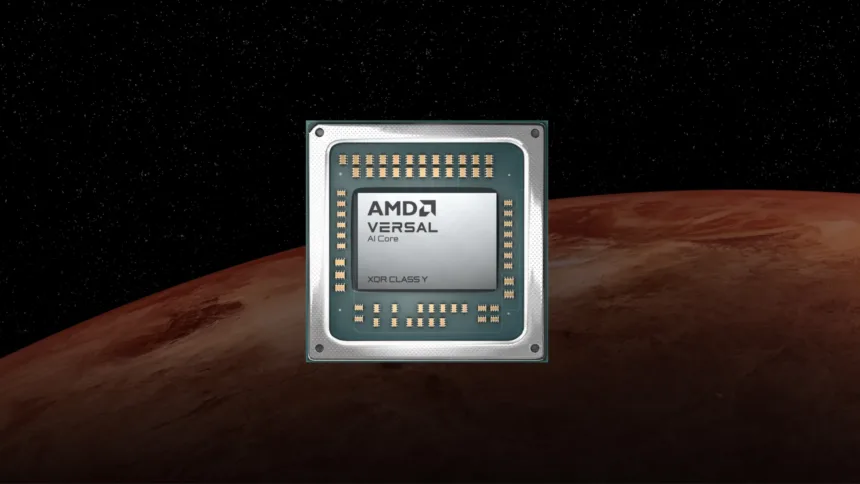
AMD has started shipping samples of its Versal AI Core XQRVC1902 with a new space-grade package designed for missions lasting up to fifteen years. The 1 October announcement focuses on the component’s reliability and its integration into long-duration systems. This is not the debut of a consumer processor with a higher clock speed: the important change is how the chip is protected, cooled, and connected.
The manufacturer uses a reinforced organic substrate and a lidless design, intended to mitigate thermal and mechanical stress. The package includes space-grade capacitors and maintains pin compatibility with VC1902 devices in other product lines using the 2.197-contact format. For someone designing a board, keeping that interface can make it easier to upgrade the system without redesigning all its connections.
What an adaptive SoC does
Versal documentation describes a combination of Arm processors, programmable logic, and specialized compute engines. A processor executes software instructions; programmable logic lets users configure circuits for specific tasks; AI Engines are designed for parallel operations, such as signal processing and certain machine-learning algorithms. The platform brings these elements together to distribute work according to its needs.
On a satellite, data often starts as a signal from an instrument. Filtering, transforming, or classifying it before sending it to Earth can reduce the amount of information that takes up the communications link. A conceptual example would be separating relevant captures from others that do not meet a criterion, while maintaining scientific control over the selection. This does not mean the announcement has already identified a specific mission that will do this.
It also matters that processing can be adapted over the system’s lifetime. Reconfigurable logic provides a way to modify certain functions, within the mission’s design and constraints. This is a substantial difference from a circuit built for a fixed operation, although each configuration must be carefully validated.
Fifteen years is a design goal
The samples let customers build engineering models and evaluate integration. AMD is conducting tests for MIL-PRF-38535 Class Y qualification and expects flight-qualified units in the second half of 2027. The announced duration expresses the type of mission the package is intended for; it does not certify that these units have operated in orbit for fifteen years.
The distinction between a sample, a qualified component, and a complete system is essential. A spacecraft needs to validate power, thermal management, fault tolerance, and the behavior of the system as a whole. Changing the package addresses one part of that work, but does not replace mission testing.
The announcement matters because it brings more processing capability closer to environments where repairing or replacing a board may be impossible. In that context, chip selection depends as much on what it computes as on evidence that it can keep doing so for years.