
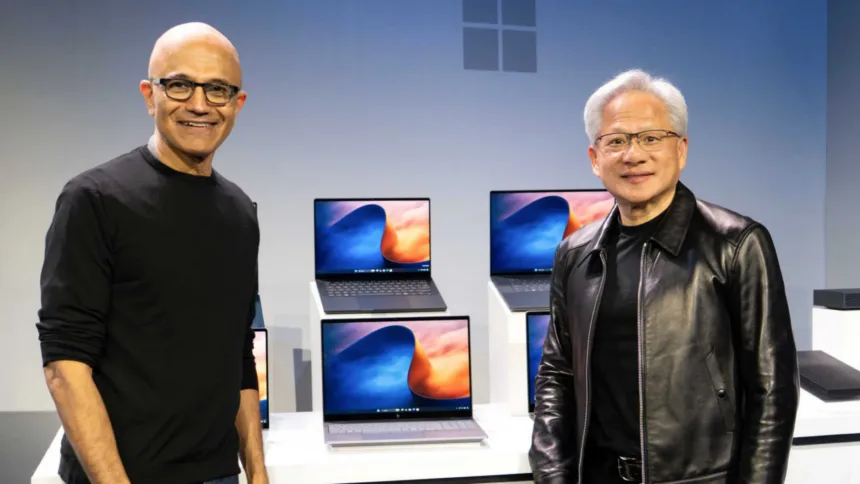
RTX Spark laptops will be available starting October 16, and reservations opened on the 7th, according to NVIDIA. Compact desktop systems will arrive in November. The platform combines an Arm-based Grace CPU with Blackwell RTX graphics and up to 128 GB of unified memory, a configuration aimed at both local AI and creative applications and games.
The maximum announced specifications include twenty CPU cores and 6,144 GPU cores, with a 600 GB/s CPU–GPU link. NVIDIA also advertises up to one FP4 petaflop. That last figure describes low-precision computing capacity for AI; it does not correspond to traditional graphics performance or allow you to rank a laptop against any GeForce card by gaming speed.
Shared memory: what it solves and what it doesn’t
With a conventional system featuring a dedicated GPU, a model can be limited by that GPU’s memory even when the system has plenty of RAM available. A unified memory architecture offers another way to host and share data between processors. That’s one of RTX Spark’s central selling points for running large models close to the user.
That headroom is still finite. The operating system, applications, and inference caches compete for capacity. Running a model while editing video, for example, doesn’t use the same amount as a demo dedicated solely to chat. To compare configurations, it’s useful to know how much memory remains available under a real workflow and what happens as they approach the limit.
The link between the CPU and GPU should also not be confused with the speed of any memory or external connection in the system. Every part of the path has its limits. A high interconnect figure doesn’t automatically eliminate the time needed to load a model from the SSD or move data over the network.
Surface Laptop Ultra shows a specific implementation
Microsoft introduced Surface Laptop Ultra with a 15-inch touchscreen and user-removable storage. The announcement describes USB-C, HDMI, and USB-A ports, an SD card reader, and a 3.5 mm audio jack. For content creators, that combination matters because of the devices they connect and the files they move, in addition to inference capacity.
Microsoft also highlights a new thermal architecture. The practical reason is simple: a laptop has to dissipate heat while sustaining a prolonged workload. A brief test and an export or inference process sustained for many minutes don’t demand the same thing. Temperature, noise, and operation on battery or while plugged in are data that should accompany performance figures.
Windows on Arm adds another compatibility check
Windows 11 can run x86 and x64 applications through emulation, but drivers need native Arm support. That’s why the list of programs, peripherals, and add-ons you use still matters. Having a Blackwell GPU doesn’t by itself guarantee that every component in an older workflow will work without changes.
The note about games on RTX Spark explains that compatibility issue in more detail. Compared with DGX Spark, which uses Linux-based DGX OS, these laptops offer a portable Windows environment. The shared name doesn’t make the two product families the same product or equivalent purchases.