
The James Webb Space Telescope made it possible to identify the host galaxy of the most distant known fast radio burst, FRB 20240304B. The result, published on October 8 in Science and announced by NASA, places the emission when the universe was approximately 3 billion years old. The surprise was not just how far away it was: the signal came from a dwarf galaxy that was actively forming stars, an environment that offers clues about what may have produced it.
A 2024 detection, with its distance confirmed now
Fast radio bursts, known as FRBs, are emissions that last just milliseconds. They were first discovered in 2007, and their origin remains unresolved, in part because most are observed only once. In this case, the MeerTRAP project detected the signal with the MeerKAT radio telescope in South Africa on March 4, 2024; the new result comes from a study of its host galaxy.
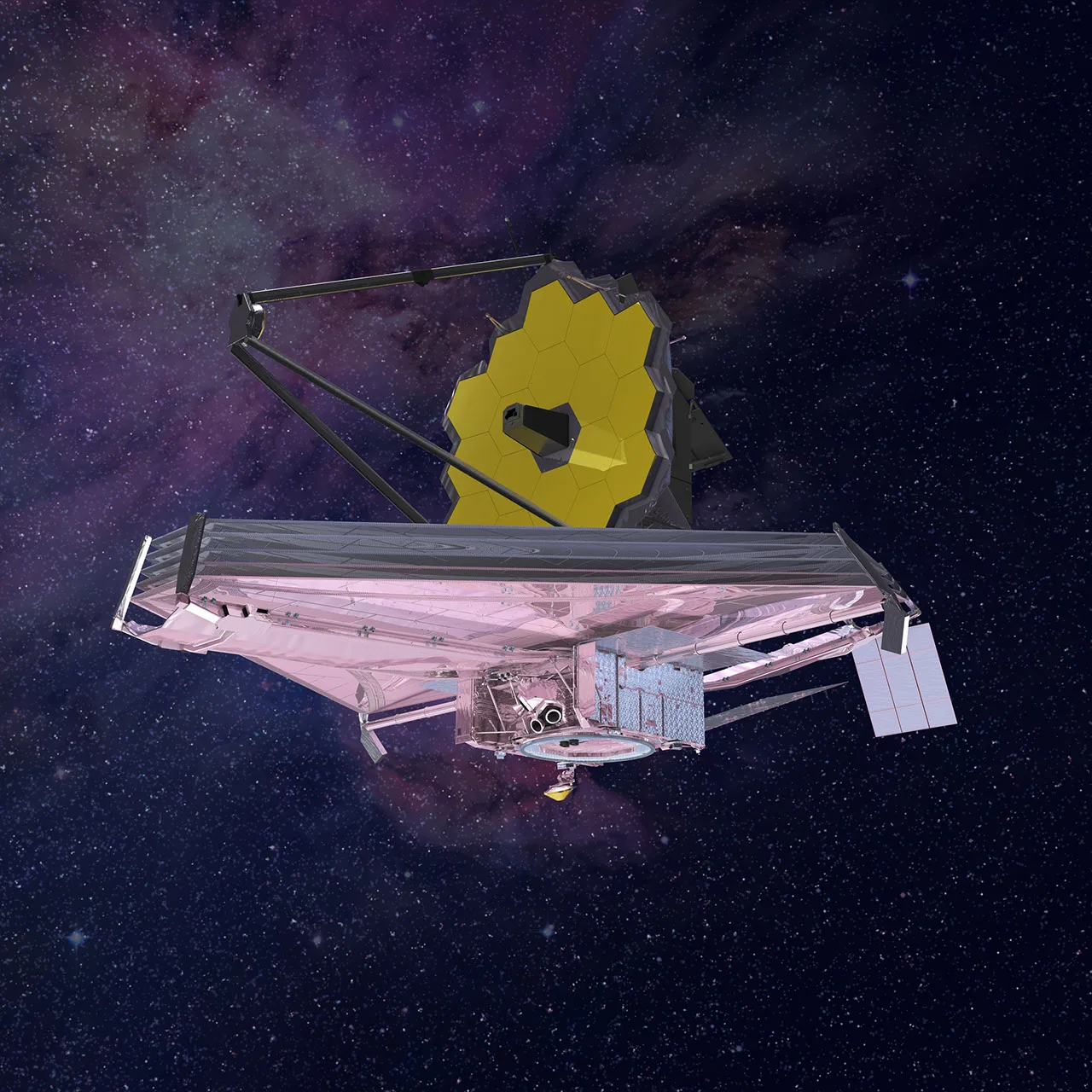
Radio data already pointed to an extreme distance and made it possible to pinpoint the signal in the sky. However, the largest ground-based telescopes could not distinguish a galaxy at that position. Webb resolved that issue with two instruments: NIRCam detected the host in infrared, and NIRSpec measured its redshift, 2.148, allowing the team to establish the cosmic era of the emission.
The reference to 3 billion years describes the age of the universe when the burst occurred, not how long the signal took to reach Earth. Space.com explains that it traveled for around 11 billion years. This distinction between the time of emission and the journey helps clarify what astronomers observed: an ancient signal and the galaxy that produced it at an early stage in cosmic history.
A small galaxy favors the magnetar hypothesis
According to NASA, the galaxy turned out to be a thousand times less massive than the team expected. This sets it apart from most known FRB hosts, which tend to be massive galaxies with star formation. Its activity suggests that most of its stars may have formed in just 30 million years, during the period when star formation reached its peak in the universe.
That environment helps compare two possible explanations. One proposes the merger of two neutron stars, whose approach and eventual collision can take billions of years. The other posits a young magnetar: a neutron star with an intense magnetic field, formed after a supernova and capable of producing a burst without such a long wait. Manisha Caleb, the lead author, considers a merger very unlikely in this case; the evidence favors the second possibility, but does not confirm the mechanism.
The signal also makes it possible to trace matter between galaxies
The finding is useful for more than studying the emitting object. As the radio signal passes through matter between galaxies, it retains information about its journey. The team identified traces of two structures: a previously unknown galaxy cluster, with a redshift of 0.3, and the Virgo Cluster, located about 54 million light-years from Earth. Thus, a very brief emission can help study material that is difficult to observe directly.
The next step will be to expand the sample of distant signals and characterize their galaxies. The researchers estimate that MeerKAT could detect and locate several FRBs per year with a redshift greater than 1; this is a projection, not a number already observed. The approach demonstrated here assigns different tasks to each observatory: the radio telescope finds the burst, and Webb makes it possible to study a host too faint for the largest ground-based telescopes.