
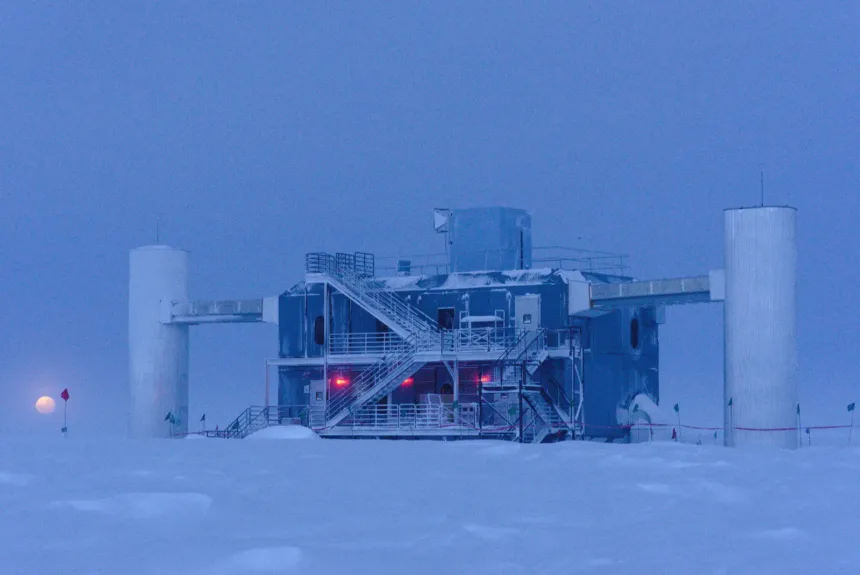
The 2026 Nobel Prize in Physics recognizes Francis Halzen for his contributions to IceCube and the discovery of high-energy neutrinos of astrophysical origin. The observatory confirmed the announcement on October 6. Its instrument is unlike a conventional telescope: it uses an enormous volume of South Pole ice to record signals from particles arriving from space.
The idea takes advantage of a challenge. Neutrinos interact so little with matter that they can travel great distances without stopping. This quality makes them interesting for investigating cosmic phenomena, but also makes them extremely difficult to detect. It takes a lot of material and patience to observe the few interactions that do occur.
What the detector actually sees
IceCube contains optical sensors distributed throughout the ice. When a neutrino interacts, it can produce charged particles that leave a characteristic emission of light, called Cherenkov radiation. The sensors record when that light arrives and how intense it is.
The reconstruction uses this data to estimate properties of the event, such as its energy and direction. It is not a direct photograph of the neutrino: it is a physical inference based on the trace left by its interaction. Understanding how light behaves in the ice is essential to making that reconstruction accurate.
An astronomy that complements light
The observatory recalls three milestones: the identification of high-energy astrophysical neutrinos in 2013, later evidence of emission associated with galaxies, and the observation of neutrinos from the Milky Way announced in 2023. These are results accumulated over years, not discoveries all made this week.
The value of this astronomy lies in adding another kind of messenger. A source observed with light and particles can offer complementary information about the processes that accelerate matter to extreme energies. It also requires distinguishing a suggestive coincidence from a statistically robust association: seeing two signals close together in the sky is not, by itself, enough to establish a common origin.
What comes after the award
The collaboration installed IceCube Upgrade during the 2025–2026 season and expects to obtain its first scientific data later this year. The upgrade aims to improve the calibration of the ice and expand sensitivity to lower energies.
IceCube-Gen2 is a different project, still only proposed. It envisions a much larger optical volume and radio techniques to investigate other energies. Confusing that proposal with infrastructure already in operation would exaggerate current capabilities. The Nobel recognizes a detector that made a new way of observing possible; the next stage aims to turn those first detections into more numerous and precise measurements.