
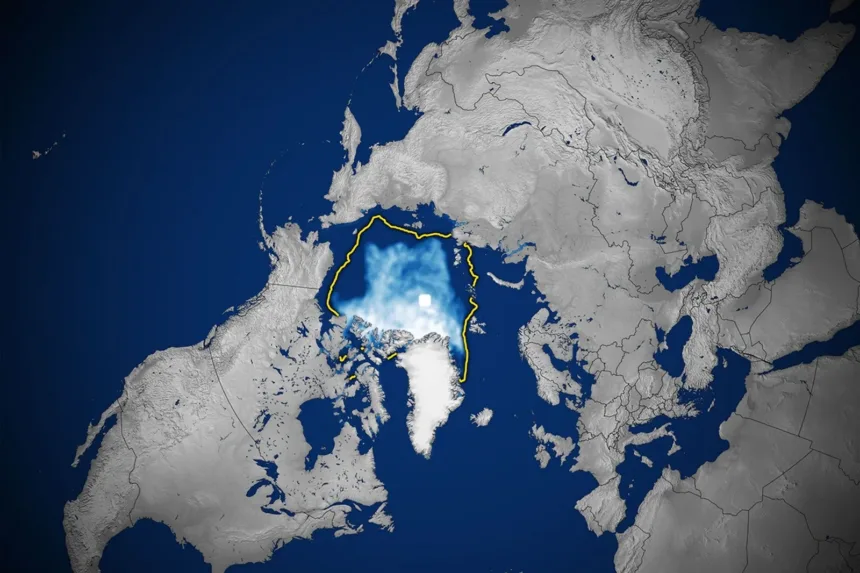
Arctic sea ice reached its annual minimum extent on 12 September 2026: about 4,6 million square kilometers, according to NASA and the National Snow and Ice Data Center (NSIDC). The report published on 7 October places it tied with 2008, 2010, and 2025 as the tenth-lowest minimum in the satellite record. The figure needs context: a year not setting a record does not mean the ice has recovered.
NASA notes that the twenty smallest annual minimums have occurred during the 2007–2026 period. That sequence matters more than treating each September as a contest for the record. Ice grows during the cold months and retreats during the warm ones; the useful comparison is between the same phase of the cycle in different years, not a summer snapshot compared with a winter one.
Extent does not mean a solid sheet of ice
The NSIDC counts an ocean grid cell as ice-covered when it reaches at least 15 % concentration. Extent is the sum of the full area of those cells. That is why 4,6 million km² does not mean a solid platform with no water between the ice floes. Ice area, which weights how much ice occupies each cell, answers a different question.
A simplified example: if two cells of the same size contain 20 % and 90 % ice, respectively, both contribute equally to the extent calculation, but not to the area calculation. This distinction helps readers interpret the maps and avoids comparing figures calculated using different methods as if they were equivalent. Extent also does not tell us how thick the ice is.
To discuss volume, both area and thickness are needed. An extensive but thin cover can contain less ice than a smaller, thicker one. Ice that survives several summers also provides different information from ice that forms and disappears within a single annual cycle. The health of the Arctic ice cover cannot be captured in a single number.
Why losing ice changes the energy balance
The difference lies in how ice and water respond to sunlight. The NSIDC explains that sea ice reflects approximately 50 % to 70 % of solar energy, compared with about 6 % for the surrounding ocean. Snow on the ice can raise the fraction reflected even further. When more water is exposed, a greater share of the energy can be absorbed at the surface.
This mechanism helps explain why the persistence of the retreat matters, beyond the size of a given year’s minimum. Weather variations also redistribute ice or contribute to its loss during each season. A decades-long series makes it easier to distinguish the trend from annual fluctuations.
The takeaway from the 2026 report is therefore specific: extent was greater than in some years with extreme minimums, but the result remains within the period of the lowest values on record. To assess a recovery, a sustained change across several indicators would be needed—not just September ceasing to rank first on the list.